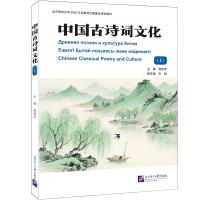
This textbook is an innovative
work guided by the integrated concept of “International Chinese Education +
Technology + Culture.” Compared with other cultural textbooks, its major
highlight is the inclusion of the module “Mutual Learning of Civilizations and
Education for International Understanding,” which aims to enhance international
students’ cross-cultural competencies including cultural understanding,
adaptability, communication and cooperation, and strengthen education for
international understanding.
The textbook is divided into two
volumes: Volume I and Volume II. Volume I contains 14 lessons, each including
the original poem, new words, collocation expansion, grammar explanation and
exercises, poetry practice, author and work introduction, cultural expansion,
mutual learning of civilizations, and dialogues. The selected poems are
organized according to Chinese cultural themes such as family affection,
festivals, friendship, and landscapes.
Closely connected with reality,
Volume I presents 15 Chinese cultural points from easy to difficult, from
surface to core, explains 30 grammar points, and designs 14 groups of dialogues
covering language points, ancient poetry, and cultural knowledge. The grammar
points are extracted from ancient poetry and standardized, mainly corresponding
to levels 1 to 3 of the International Chinese Language Proficiency Standards
and HSK, with only a few Level 4 grammar points included. Each dialogue
presents ancient poetry in real-life scenarios, that is, the situations in
which ancient Chinese poetry is used in daily life, helping students initially
develop the ability to understand Chinese culture and express themselves
interculturally.
The textbook includes diversified
interactive activities, such as poetry exercises in the form of integrated
courseware based on the smart system, recitation and singing, etc., encouraging
learners to actively participate in class activities and enhancing
self-cognition.
The selected poems are
mainly short and easy-to-understand five-character and seven-character
quatrains, classic and representative. The modular design conforms to language
learning rules, progressing from easy to difficult; word repetition rate is
high, after-class exercises are open-ended, cultural content and communicative
practice are both included, and digital resources are abundant.
Zhang Junping, female, holds a Doctoral degree. She is
an Associate Professor and Master’s Supervisor at the School of International
Chinese Studies, Beijing Language and Culture University. She also serves as a
professional practice supervisor for Master of Professional students at
Communication University of China and University of Chinese Academy of Social
Sciences, and is a lifelong member of the Society for Modernization of Chinese
Language Teaching. Her main research interests include international Chinese
language teaching resources and intelligent Chinese language teaching.
Chinese Classical Poetry and Culture (I) is a textbook designed for absolute beginners of
Chinese with zero prior knowledge, specifically catering to those whose native
languages are English, Russian, or Kazakh. It employs Chinese Pinyin and
translation-based methods, along with multidimensional digital resources such
as songs, audio and video materials, and interactive multimedia courseware, to
make classical Chinese poetry easy to learn and understand. By utilizing AI and
online teaching systems, it provides teachers with flexible lesson plans,
inspires emotional resonance in learners, enhances their cross-cultural
communication skills, and facilitates mutual learning between Chinese and other
civilizations. More than just a language textbook, this book serves as a vivid
gateway for overseas students to gain insight into Chinese culture.
Teachers may adopt various teaching
methods such as lectures, discussions, recitations, and performances, combined
with multimedia resources such as PPT and cultural activities, to create a
vivid and interesting classroom atmosphere. Encourage students to understand
the connotations of ancient poetry through group cooperation, role-play, and
other methods, improving their language application and cross-cultural
communication skills.
The smart teaching system’s integrated
courseware is a helpful tool for students, especially in non-target language
environments, for “l(fā)istening, speaking, practicing, and singing.” It provides
instant feedback, allowing teachers to accurately track students’ learning
status and realize technology-enabled teaching.
2. Teaching
Arrangement
It is suggested that Volume I be taught
over one academic year with 2–3 class hours per week. Teaching content and
emphasis can be flexibly adjusted according to students’ actual proficiency and
progress. For students with weak foundations, strengthen explanation and
practice of language knowledge; for students with strong foundations, guide
in-depth cultural discussion and creative practice, such as adding a cultural
report week after Lesson 7.
The current order of texts roughly aligns
with traditional Chinese festivals, seasons, and semesters. For example,
“Spring Festival” can be taught during the two weeks of the Spring Festival,
and “The Qingming Festival” during the two weeks around the Qingming Festival.
“On the Pond” about longing for someone while picking lotus flowers in autumn
can be taught at the beginning of the autumn semester, and “Sympathy for the
Peasants” about cherishing food during the autumn harvest season. “River Snow”
can be taught in the coldest winter days to encourage students to stand firm
against cold and hardships. When spring comes with warm flowers blooming and
all things reviving, students can learn “A Quatrain: Two Golden Orioles Sing
Among Green Willows” and “Grass on the Ancient Plain (A Farewell)”. At the end
of the semester when students are about to part, “A Farewell to Wang Lun” is
taught to help them cherish friendship. Such a design aims to help students
better understand and appreciate the charm of ancient Chinese poetry within the
contemporary cultural context.
Some words in the collocation and grammar
sections of this textbook, such as the character “上” in “關上” (to close) and “路上” (on the way), have the same Pinyin as
the new words in ancient poetry. In modern Mandarin, “上” is pronounced in a neutral tone, which
teachers can handle flexibly.
3. Extended
Learning
Encourage students to expand learning channels after class through
reading relevant books, watching cultural programs or videos, and joining
poetry clubs, deepening understanding and love of Chinese ancient poetry
culture. Meanwhile, guide students to apply the poetry knowledge they have
learned to practice, such as poetry creation, recitation, or singing
performances, enhancing learning effect, drawing wisdom from the ancients, and
enriching modern life.
BEIJING LANGUAGE AND CULTURE UNIVERSITY PRESS CO.LTD
Mailing Address: No. 15 Xueyuan Road, Haidian District, Beijing 100083
Tel: +86-10-82303645 Fax: +86-10-82303908
Copyright ? 2026 Beijing Language and Culture University Press Co.Ltd. All rights reserved.